Sunday, 18 December 2016

Volunteers 2016

Some examples of the work volunteers have been involved with in the Central and East Lakes region over the course of 2016.

A special thank-you to all the volunteers who helped in the clean up in the Central and East Lakes region after the devastating damage caused by a succession of storms in December 2015.


Thanks also to the volunteers who throughout 2016 have been an invaluable help on various projects...including...
Cumbria NT Volunteers "bracken bashing" around juniper trees..Langdale.

Working Holiday Group putting in new steps at Millerground....
... major upgrade works to Millerground path...
...and lake-shore revetment work.
Cumbria NT Volunteers "plug planting" wild flowers near Grasmere.


Windermere School involved with touch me not balsam and netted carpet moth conservation work at St. Catherine's.


Reinstating the pond in the walled garden at St. Catherine's.
Volunteers resurfacing footpath at Ullswater during "Fix The Fells Day".

Volunteers from Stickle Barn involved with Himalayan balsam control at Elterwater.


Monday, 5 December 2016

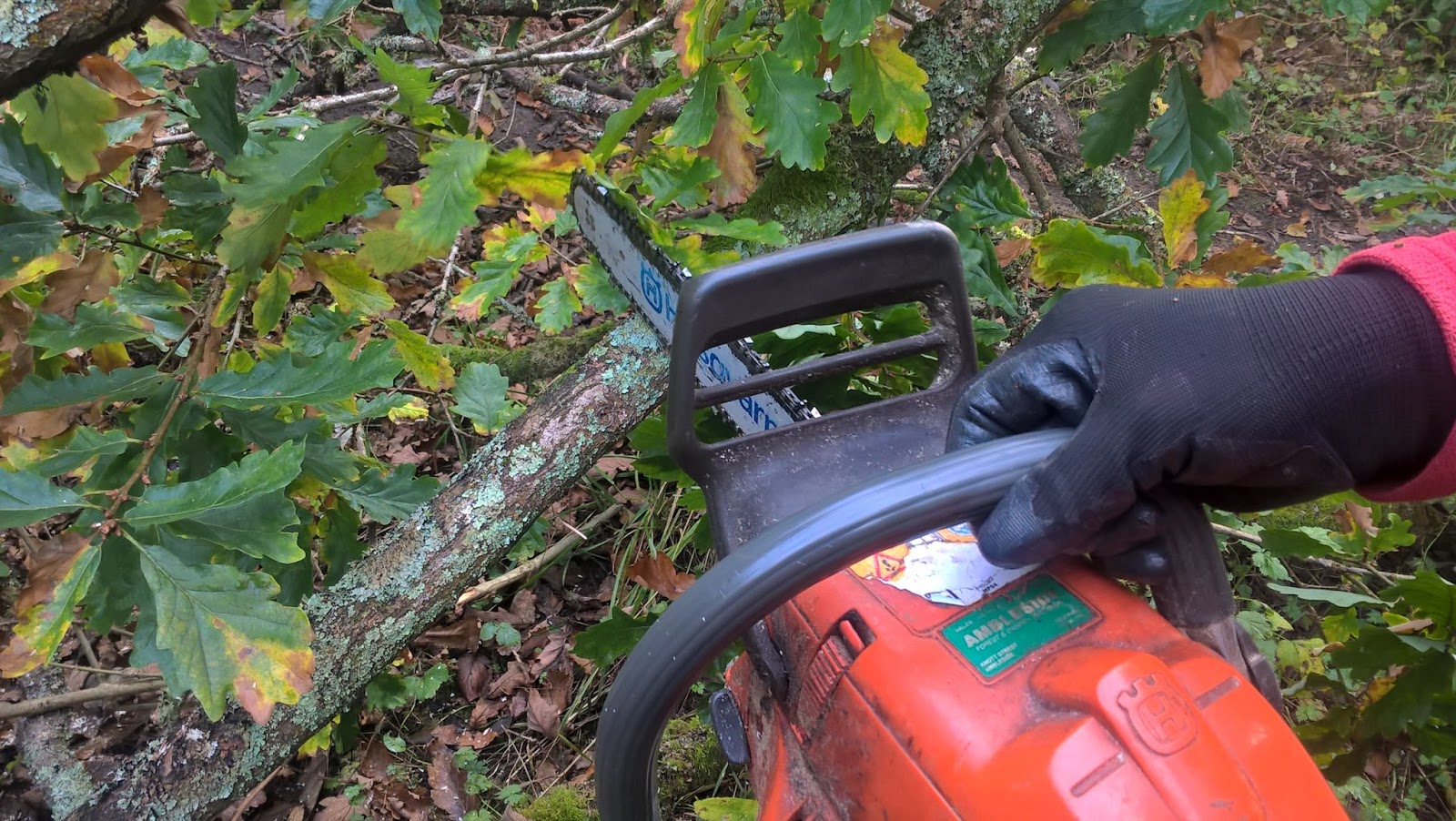
Downed beech tree across a footpath.

On the way to do some tree planting... (Wednesday November 30th) on land belonging to The Howe Farm at Troutbeck, above Windermere,... this fallen beech across the footpath was discovered!
The tree had come down in the recent high winds partially blocking the footpath with the crown resting on a neighbour's property. The next day, Liam, forester ranger based at St. Catherines, can be seen here working out the best approach to deal with the tree.
Jess from High Close, who like Liam is also qualified to do large tree felling, was able to give assistance at very short notice. With warning signs set up and a lookout in place to warn walkers using the footpath work began.
In this image Jess has reduced the crown of the tree. Most of the wood will be cross cut and used for firewood... (after seasoning)... in the NT Footprint wood-burner.
Here Liam is cutting more sections out of the tree trunk to further reduce its weight prior to "felling" it..
Above and below.
Working down to where the tree is resting on the bank.
A robin popped by to see what was going on.
Finally the main trunk was winched to the side of the path and out of the way, ready to be dealt with later.
Jess kindly volunteered to do the winching.
Liam and Jess...what a team!
The first of many loads of wood on the way to St. Catherine's with the wood-burner as the final destination.


Sunday, 6 November 2016

The walled garden pond...St. Catherine's.

Academy ranger Bruna Remesso, with volunteer help, has done a great deal of work in the walled garden at St Catherine's this year.
One of the jobs she undertook was to reinstate the old pond. It was dug out afresh and a new pond liner was put in place.
Stone dredged out of Troutbeck, after Storm Desmond, was selected to be used for landscaping the area around the pond. 
A volunteer group from Windermere School, who help out on most Thursday afternoons on various tasks, began landscaping work with Bruna.
A busy scene unfolds!
Smaller stones were put in buckets and...
...carried over to the pond.
looking promising.
Really taking shape.
Almost done. Approximately two and a half tons of stone was used for the pond.
The large rounds of wood floating  in the pond are alder. They have had large holes drilled in them as refuge sites for frogs and newts; hopefully they will colonise the pond.
The Windermere School group with Bruna on the right.
Julie King, Director of student pathways and careers at Windermere School, quite literally threw herself into the task, giving the term pond dipping a whole new meaning. She also ably demonstrated just how deep the pond was!

Friday, 28 October 2016

Variety

Last week, Monday 24th of October to Friday 28th, a number of small jobs were ticked off by the ranger team at St. Catherine's.
Lets start with a fallen oak blocking the footpath at Bordriggs Brow, Bowness on Windermere.
After our usual Monday morning litter sweep of the lake shore properties, Jenkyns Field, Cockshott Point and Millerground, we set to work.
With the path clear, the cut up oak was transported back to St. Catherine's...
 ..."processed" into firewood and stacked in the log store for seasoning, ready to be used in the Footprint wood burner.
Next up four farm gates for High Lickbarrow  Farm were undercoated and later painted in high gloss red. This colour is quite a feature of the farm's "colour scheme"!
This is the five foot gate, dazzling!..the other three gates are ten foot in length.
Next on the agenda, stone setts were used to create a defined border between the walkways, grassed area, flower beds and raised beds by the Footprint building.
Looking, dare I say, not bad!
the power barrow, proving its inestimable worth yet again, was used to collect gravel...
 ...and distribute it along the walkways around the raised beds.
The power barrow was also pressed into service to collect stones washed down
in the floods and then cleared into heaps along Troutbeck.

These stones will be used to landscape the newly dug out pond in the walled garden at St. Catherine's.
Our last job, during the week, was to repair a woodland wall gap above St. Catherine's. (The metal hurdle was put in place in case sheep were brought into the field before the wall had been rebuilt.)
Yes Blue! You are a great help!
Almost there.
Done and dusted. Back to the Bat Cave to write this post, have a coffee, and wind down for the weekend!

Friday, 14 October 2016

Touch-Me-Not Balsam and Netted Carpet Moth Conservation with Windermere School

St. Catherine's is an important site for scarce annual touch me not balsam plants. It is the UK's only native balsam, with the Lake District being its principal stronghold.
One of the rarest moths in the UK, the netted carpet moth, is totally reliant upon touch me not as it is the only food source for its caterpillars.
Unlike its relative, the highly invasive himalayan balsam (see above), touch me not is incredibly...if not... annoyingly fussy about its growing conditions! It likes nutrient rich soil in damp open woodland with just the right mixture of sun and shade. It is also very bad at competing with other plant species so it tends to opportunistically colonise bare or disturbed ground where it is sometimes able to form dense stands.
Nettles, creeping buttercup, and brambles overwhelmed some of the touch me not stands at St. Catherine's last Summer, so to give the plant a boost for next year, hopefully with a corresponding increase in moth numbers, a more intensive conservation programme has been initiated.
Students from Windermere School have been most helpful in pulling up nettles, brambles and disturbing the ground.
Incidentally, in NT Coniston woodlands, cattle have been instrumental in increasing the plant numbers hence moths by poaching the ground most effectively during Autumn and Winter months..sadly not an option at St. Catherine's!
Forks have proved useful in digging over the ground; the aim is for the touch me not seeds to germinate more readily and establish dense stands in Spring with the competition from other plants largely eradicated from this area.
Mrs Julie King, Director of student pathways and careers at Windermere School also helped with the conservation work... seen here getting to grips with a deep rooted bramble!
These images of the netted carpet moth were taken by Richard Dennison during a 'Moth Night' at St. Catherine's... late July 2016; he kindly gave permission for them to be used on this blog-site..
..Excellent images of moths on touch me not Balsam.

More conservation work will be undertaken at St. Catherine's right up until late March or until the first touch me not seedlings are spotted!