Thursday, 5 May 2016

Helicopter Lift at Troutbeck Park Farm.

A large quantity of  fencing materials required  transporting onto difficult to access upland areas of  the National Trust farm, Troutbeck Park Farm...(including The Tongue and Yoke). A helicopter lift was deemed to be the most cost effective and efficient means of achieving this. 

British International Helicopters were contracted to do the work here, and elsewhere in The Lakes, by the National Trust in partnership with the Lake District National Park Authority.

The fencing materials are needed to repair flood damaged boundaries and to stock proof certain areas from sheep; the aim here is to improve wood pasture land by a conservation grazing regime with limited numbers of cattle.


Prior to the day of the lift, much preparation work was needed such as stacking the fence posts into bundles and roping them up. The stock netting and barb wire were put into one tonne bags.

Leo, the Knot Maestro! 


Quantities of fencing materials and even more 'bundles' higher up the slope.

The British International Helicopters' BK 117 C1 G-RESC refuelling on the day of the 'lift'...May the fifth.


The lift in progress...this helicopter has a lifting capacity of 1.2 tonnes.


A close up....


...and an image at 25X zoom, approaching the drop zone.


!!

Another 100 posts on their way to The Tongue, the summit of which can be seen in the background.

With special thanks to the pilot and ground crew of British International Helicopters.

All the fencing materials were flown to their designated drop zones in less than half a day...Impressive!

Thursday, 28 April 2016

Spring is here?

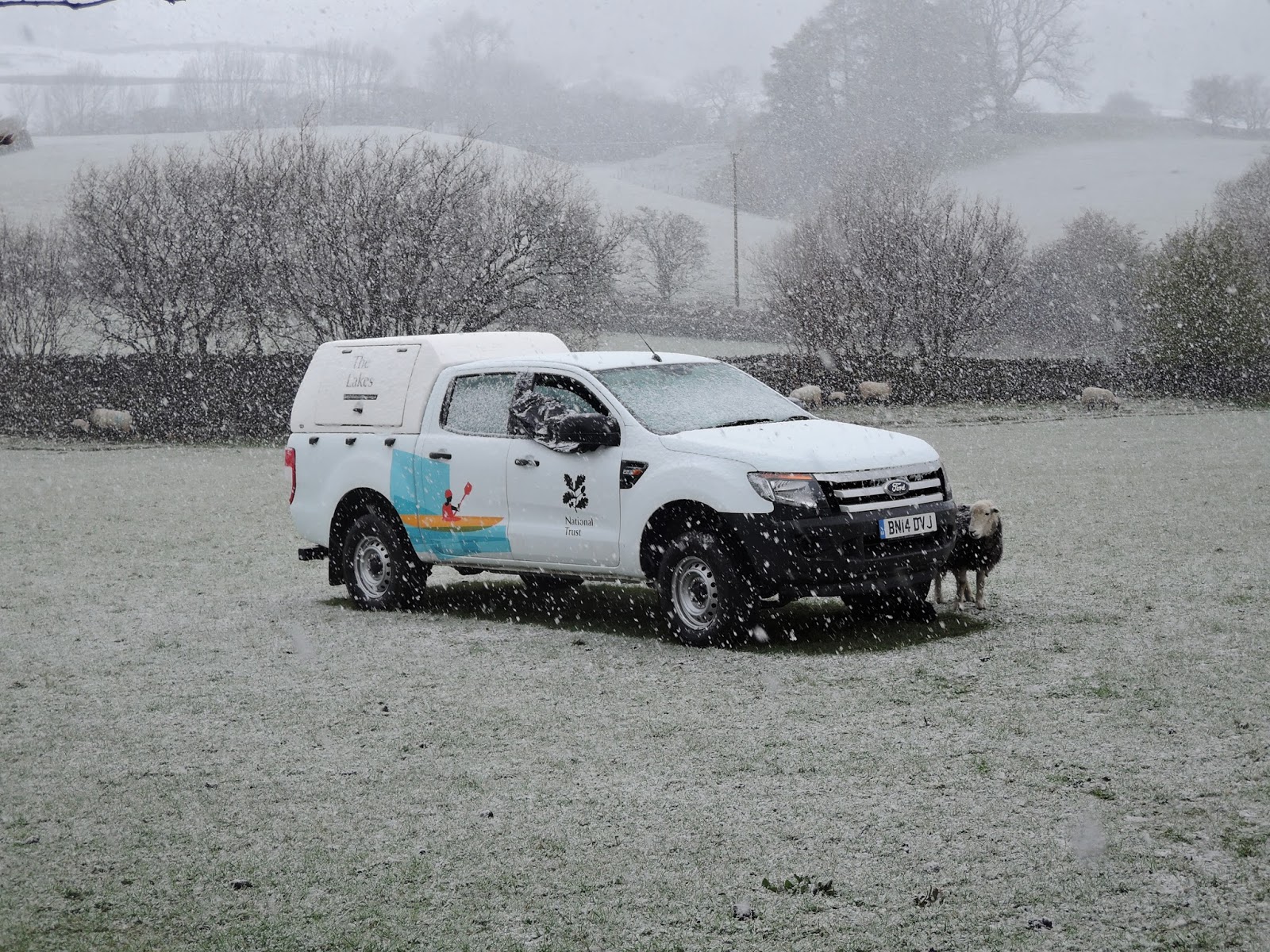
After several days of glorious sunshine, the arrival of blizard like conditions came as quite a shock on this day, Thursday the 28th of April...in the Troutbeck Valley.

Our Ford Ranger...

...was instinctively sought out as the best shelter available by this lamb of just a few hours old born this day, Thursday 28th of April...in the Troutbeck Valley...

The anxious ewe keeps a weather eye on her off-spring!

Friday, 15 April 2016

PLASTIC FANTASTIC!

 Whilst working on a roadside footpath near The Howe Farm, Troutbeck, Bruna Remesso, Academy Ranger based at Saint Catherine's, saw this impressive looking fungi. Intrigued,  she took some images with her mobile phone camera of it...

 ...growing on...

...a wrapped hay bale! 

Just a tiny hole in the bale wrap has enabled the fungi within to fruit like this...anyone know what variety this one is?

Tuesday, 12 April 2016

Spread of Invasive Himalayan Balsam after the Floods.

Alarming increases in the numbers of Himalayan Balsam seedlings are taking root at Millerground, on the east side of Windermere, this April. (See image below). 

Winter flood water has dispersed seeds from upstream over a much larger area than usual and in much greater concentrations than seen in previous years.
 
Himalayan Balsam is highly Invasive and will take over large areas if not  controlled.

 Millerground is an important site for the rare native Touch-Me-Not Balsam which, sadly, is easily out competed and ousted by alien plant species especially Himalayan Balsam.
This is an image of a Himalayan Balsam seedling. The heart shaped leaves running from top left to bottom right of the image are the cotyledon leaves which are present in the seed prior to germination. The first true leaves formed after germination are to be seen diagonally from top right to bottom left. 
Incredibily, there are over three hundred seedlings in this large handful pulled up from just a small patch of ground at Millerground. Each seedling has the potential to grow to over three metres in height and produce up to eight hundred seeds by late Summer.....
....to form dense stands like this one in following seasons. This stand was photographed in July on privately owned land above Millerground and on the same water course, Wynlass Beck, that flows through Millerground.
Here is another stand by the side of Wynlass Beck slightly further upstream growing alongside yet another horribly invasive plant, Japanese Knotweed.

The two invasive species appear to have formed an unholy alliance! Their growth rate is so prolific they have formed a virtual canopy over the stream here, all but eliminating any native plants on both sides of Wynlass Beck in this area and beyond.

Without due diligence, by the rangers, in combating invasive plants on Trust land...Millerground potentially could and probably...would...look very similar! 
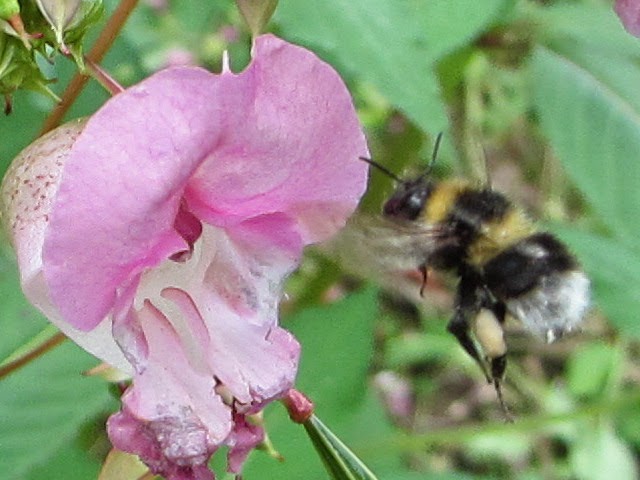
Pollinators, mainly bumblebees, find Himalayan Balsam utterly irresistible as it produces vast quantities of nectar with a high sugar content over an extended flowering period; (like putting a child in a sweet shop with no restraints!)

 Pollinators often ignore native plants, considerably reducing their seed set, in favour of this alien invader! This assists in the spread of Himalayan Balsam which adversely alters the ecological balance and nature of riparian and wetland habitats.

Eradicating or at least reducing the numbers of Himalayan Balsam will 'encourage' pollinators to actively seek out native plants. This should increase their numbers allowing them to make a comeback in areas previously dominated by Himalayan Balsam, improving biodiversity...particularly in wetland areas and alongside river banks.
Touch-Me-Not Balsam stand at Millerground last Summer; intensive eradication of Himalayan Balsam in this area has allowed the native balsam to flourish here.
A close up of a Touch-Me-Not flower.

Even more extensive eradication work will be needed at Millerground this season to prevent....
...this...
...causing this...
...and this to occur year after year.

Friday, 8 April 2016

This post has no title...just words and piccys.

Today, Friday 8th April, the Trust tenant farmer at Causeway Farm brought three ewes with their day old lambs to the parkland at St. Catherine's.

A well earned rest after a bout of heavy drinking!

 St. Catherine's is very popular with dog walkers so,with the arrival of the livestock, these signs were immediately put up by Trust rangers at access points into the parkland. 

 
With livestock back in the parkland, a priority job was to clear the gravel (that had been washed down in the Winter floods) out of the cattle-grid.

Livestock might have learnt how to negotiate this cattle-grid, as it was full to the brim with gravel over a large area, and wander out onto the road. Normally this cattle-grid is lifted out for cleaning purposes but the gravel had completely covered the fixing bolts...

....so the Spring Clean had to be done the hard way.
Trowels were used to scoop out the gravel between the bars...

...after loosening the impacted gravel with a bar (colour coordinated of course)...

...and or a mattock.

The gravel was used to resurface a boggy section of the nearby footpath.
Recycling at its best!

The gravel was dumped...

...and 'raked'....

...to give a much better surface to this popular footpath.

Work in progress.

After well over two hours of hard work, and a fair amount of empathy from passers-by,* the job is done!
*The following are some of their comments... "Rather you than me"..." Don't envy you that job"..."You'll be ready for the weekend after clearing that lot away"..."Do you always get the best jobs?"...BUT OF COURSE!

(The ramp at the top right hand corner of the cattle-grid is just visible in this image. It is designed to allow hedgehogs and other wildlife to escape from the depths of the grid should they tumble in).

The daffodils in the parkland...a particularly fine display this Spring.

Wednesday, 30 March 2016

The Jurte at Saint Catherine's.

Yesterday, Central and East lakes Rangers based at Saint Catherine's spent part of the afternoon erecting a 'jurte', with invaluable assistance from Debbie, the Footprint Supervisor, and her two daughters, Rosie, and Hannah back home from university.

Jurtes originate from Germany and look like a cross between a bell tent and a yurt; they are extensively used in Germany as scout tents.

The jurte will be used as a heavy duty shelter for green wood carving courses and for school and family bush-craft camps.

In this image Ray and James are transporting the jurte with all its ancillaries...in the inestimable tracked power barrow... up to the wood above the Footprint building and on to site.


The start of the 'unboxing'.

The main roof section being unwrapped.

The site.

The wild daffodils were dug up to be transplanted out of harm's way.

The three centre poles being lashed together.

The roof being spread out...all 8 metres of it!

"YOU GOT ME IN CHAINS"!

Getting ready to raise the roof.


"...did we do that last bit correctly?  I'm not so sure, but hey ho let's give it a go!"

Debbie, Hannah and Rosie ready to lift up the side poles having attached the guy ropes.


Hannah supporting the wooden side pole while James hammers in the steel peg which will tension the guy rope.

Hammering in the peg.


The almost completed structure. There is an option for side panels but it was considered that keeping the structure open will allow people to feel more in tune with the beautiful surroundings.

The central roof opening which may be used as a smoke vent for wood fires. There is a roof cap that can be fitted in the worst weather conditions.


Finally, today (30th of March) Bruna, Academy Ranger who has recently moved to Saint Catherine's  for a year,  planted up the daffodils that were removed from the site yesterday.