Thursday, 28 November 2013

Troutbeck Fencing Project with the National Park Fell Futures Apprentices.


The first batch of fencing  materials arriving on site.
National Trust rangers based at St Catherine's had the pleasure of working with the National Park Fell Futures Apprentices.

In just a few days the first phase of a big fencing project, in the Troutbeck Valley, was completed.

The aim is to fence off a long stretch of Troutbeck to exclude livestock; this will assist natural regeneration, reduce erosion to the riverbank, and lessen the risk of flooding.

Apart from the fencing work, six new gates were installed for access along the length of the new fence line.
Distributing the fencing materials along the line of the new fence.
Part of the Troutbeck river bank soon to be fenced off.
The fencing work well under way with the gates and posts  awaiting installation.

Three of the apprentices working well as a team........
.........and with Trust!
Cutting back some inconvenient thorn that was in the way.
More Teamwork

Tidy Job.

The uneven ground proved challenging in places.  In the left foreground, the bottom plain wire, the stock netting and the barbed wire have been fully tensioned. Beyond the strutted strainer post, the barbed wire has been laid out on the ground, ready for tensioning or straining. From the next strainer post, the stock netting is about to be tensioned.
Another batch of posts and stock netting (Rylock) loaded up and ready to go.

Strange phenomenon at Troutbeck.......An Astral Mug!?....Weird or What!?

Quite a distance.

Getting the gates, posts and rails to the more inaccessible parts of the ground by means of the invaluable power barrow. Landrovers have their limitations.

Neat post and rail job on part of the fence line.

Using  a post hole digger.
Lining up the gate post......
......and getting the gate positioned.

Yet another gate further along the line ready to be fenced up to for phase 2 of the project.
A celebratory leap after completing phase one of the fencing........who was it that said "Youth is wasted on the young"!?...............SURELY NOT!
What a team! With all good wishes for the future from the National Trust Countryside Rangers at St Catherine's.


Tuesday, 19 November 2013

Cumbria National Trust Volunteers at St Catherine's.

On Sunday the third of November, the Cumbria National Trust Volunteers joined forces with the Ranger Team based at St Catherine's.

The work, at St Catherine's, entailed cutting back rhododendrons and clearing away brash from trees that had been recently felled, in order to open up the views to and from the Footprint Building.

The path up to the wood was also resurfaced with bark chippings.


Clearing away the brash and burning up.

Raking up leaves from the carpark. The Footprint is in the top left background.
Loading up the power barrows for the footpath work.
 Lots achieved at St Catherine's on a wet and blustery day. Thank you "CNTV" for all your help.

Friday, 15 November 2013

Trees + Cows = Wood Pasture

"Trees seldom grow old in woodland...ancient upstanding trees are an indication that a site is not an ancient wood" (Rackham 2006)

What is Wood Pasture?

Wood pasture is the combination of the right sort of grazing animals and widely scattered ancient trees.

This definition sounds simple but there is more to it than that. By the right sort of grazing animals we mostly mean cows, and accept that some wild deer will pass through. Cows graze by using their long dextrous tongue to wrap around the vegetation and rip out clumps, which sounds less than ideal but this method produces a variety in height of vegetation and the tiny pockets of bare ground created are perfect for tree seeds to fall into and germinate. Deer browse more on young trees than they do on plants but provided their numbers don't get too high then the regeneration of trees should outweigh deer consumption. Cows may also browse on the shoots of young trees but provided the numbers are low, for example 8 spread over 50ha then plenty of young trees will grow.

Wood pasture with its sun-loving ground plants and ancient, open-grown trees.


What isn't Wood Pasture?

Wood pasture is not improved farmland (made so by added fertilisers) on which sheep are grazing with large trees dotted around the fields or their edges. The definition of grazing animals around mature trees fits but this landscape is lacking in native herbs, grasses, sedges, ferns, bracken, heather, mosses, deadwood laying on the floor and wet, boggy or marshy areas, together with all the other wildlife that is associated with them.

Wood Pasture is not the remnant of a woodland, it was not a closed canopy of trees that has been damaged by grazing and slowly the young trees died out leaving just a few to remain. Wood pasture, which 1000 years ago covered one-tenth of the whole of England, will soon in-fill with young trees shading out the veteran trees and forming a woodland if grazing stops. However woodland plants which spread at a glacial pace will take a very long time to colonise any new woodland.

So What is the Difference Really?

Wood pasture has trees from acorn to ancient and plants adapted to open sunny ground, whereas ancient woodland contains shorter lived trees but has ancient shade-adapted plants. Farmland may have veteran trees surrounded by mostly rye-grass and parkland will be similar but hopefully with young trees in guards.

Parkland trees like these oak and beech at the St Catherine's estate near Windermere had the space to become open grown, however parkland trees sometimes lack lower branches which were removed long ago for access. The oak's successor can be seen bottom left of the photo in a wooden guard.


What is the Significance of Wood Pasture?

The misconception that Britain was a long, long time ago covered wall-to-wall in trees is proved wrong by the wood pasture ecosystem. The late Francis Rose thought the same because of the native wildlife, especially lichens that existed in Britain and Europe in this particular habitat.
Many birds that are considered common are most at home in the environment of wood pasture or at least in the sunnier edges of woodlands along with many insects and especially butterflies. If Britain was a vast carpet of trees then why do we have countless thousands of species adapted to, or benefiting most from the open sunny areas that are found between the trees?
Those who are familiar with Franz Vera will know of his (2000) hypothesis that pre-Neolithic 'wildwood' had more in common with landscapes that can be described as savanna - which I'm sure will put a very different image in peoples minds.

So the bombshell is that what we call wood pasture, or what Franz Vera called savanna could possibly be the original, and oldest ecosystem in Britain and possibly Europe since the last ice age. If we want to restore some areas of the country to what we deem 'natural' then is this it?

The Significance of the Trees in Wood Pasture

The trees will naturally regenerate but their numbers are kept in check by the grazing of large animals such as big hairy cows. These native trees have it good; they are not in strong competition with one-another for light or water and can in fact grow to their full potential (climate and altitude depending). These trees will be what's called open grown - their trunk will be short and fat and they will have thick branches that will spread horizontally and wide. The overall shape of the tree will be that of a dome - this is the optimum shape for placing leaves in positions to capture the most sunlight which in turn provides the tree with the materials it needs to grow. The shape is also the best for diffusing the strong winds which will push on the dome shaped crown but the power will be dissipated throughout the tree. Open grown trees develop substantial buttress roots in response to continual exposure to wind. They therefore have a greater number, diversity and mass of micro-organisms associated with the roots (Ted Green, 2010).

An ancient open-grown oak in Gowbarrow Park SSSI.


A tree that has naturally grown in a woodland will be taller with its less spreading branches higher up as it tries to compete with its closely positioned neighbours for light and water. These trees will live shorter lives and provide less opportunities for wildlife to benefit from them.

Woodland or 'forest' trees grow taller, straighter with less branching lower down.

"A single 400-year-oak...can generate a whole ecosystem...for which ten thousand 200-year-old oaks are no use at all" (Rackham 2006)


Open grown trees found in wood pasture therefore have the opportunity to live their full lives and become veterans, so oak could live up to and beyond 900 years and ash can even have their life spans tripled by pollarding giving incredible continuity of an ecosystem. Open grown trees can therefore provide habitats to birds, bats, beetles, spiders, and lichens for several centuries longer than a woodland tree.

Looking to the Future

Tree experts agree that old, open grown trees are one of the most important contributions the UK can make to the biodiversity of Europe. The continuity of biodiversity over many centuries makes this habitat historically and ecologically extremely important. The National Trust in the Lake District is restoring ancient wood pasture in the Windermere and Ullswater valleys in some exciting and large scale projects starting this year.

A few open-grown trees can still be found in Gowbarrow Park SSSI, and dead trees like this alder are just as valuable as living ones. Here sheep will be replaced by cows over 50ha to allow tree regeneration.

The plantation in the background will be felled to create room for 12ha of new wood pasture. The site of the plantation and the foreground will give rise to open-grown trees grazed underneath by cows.


Troutbeck Park, Glenamara Park and Gowbarrow Park SSSI are three locations where, with help from Natural England, Forestry Commission and the Lake District National Park, we are removing sheep in favour of just a small number of hardy cows and extracting nearly 12ha of dense conifer plantations to restore a vast tract of Lake District into the most important ecosystem in Europe. These projects will be the focus of future blogs so please look out for them.

Troutbeck Park is the home of over a hundred veteran and ancient pollarded ash trees and is also the site of a wood pasture restoration project following sheep exclusion from part of this ancient deer park.


Like this Topic?
Visit other exceptional National Trust wood pasture at Calke Abbey in Derbyshire and Hatfield Forest in Essex.

Sources used for this blog:
Woodlands by Oliver Rackham, 2006 HarperCollins
The Importance of Open-grown Trees, Ted Green, British Wildlife Volume 21 number 5

Ben Knipe
Woodland Ranger


Monday, 28 October 2013

Touch Me Not Balsam Site near Ferry Nab.


This image, taken in October 2013, is of a clearing, choked with brambles, in a small wooded area on National Trust ground next to Ferry Nab.

It is an important site for the "Nationally Scarce" Touch me not Balsam plant; the rare Netted Carpet Moth depends upon it for survival, as it is the only food source for the moth larvae.

Both the plant and the moth are to be found predominantly in the Lake District, but are restricted to just a few sites.

Touch Me Not Balsam is an annual plant; it is intolerant of competition from other plants. This bramble patch has been encroaching more and more on the Touch-Me-Not stand so it is being cut back and pulled out .

Dealing with the brambles will also cause lots of  ground disturbance.

Touch Me Not Balsam tends to grow very much better in disturbed ground.


With the brambles pulled out or slashed back, many more Touch Me Not Plants should appear next Spring. In favourable conditions they form dense stands such as the one in the image below.

Greater numbers of plants, on which the moths' caterpillars feed, should help maintain or even increase the annual moth populations.

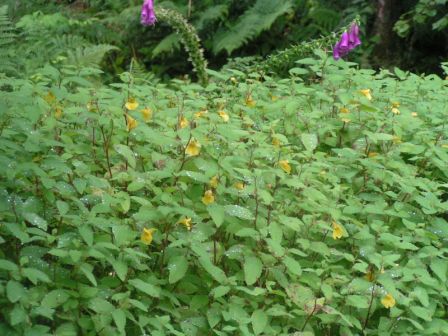
A good stand of Touch Me Not Balsam in July.


Slashing back the brambles.
Pulling out the brambles by the roots.
The site, now almost clear of the brambles.
 

Netted Carpet Moth. Mid July.


This post will be updated next Summer with a, hopefully good, progress report.
An excellent result. This is an image of the site as of the 5th of July. 2014


This is now a really impressive stand of Touch Me Not Balsam.

Tuesday, 22 October 2013

The Great British Walk 2013

 The Great British Walk-Great Langdale and Grasmere

Discover secret places, stunning scenery, wonderful wildlife and hidden heritage by taking part in the Great British Walk 2013. There are walks for families, themed walks, heritage and wildlife walks, and suggestions for walks around our autumn gardens.

All Walks start & finish from the Sticklebarn in Langdale LA22 9JU, GR NY 295065
The Easedale Round, starts at Allan Bank Grasmere GR NY 333077.
Meeting at Stickle Barn
Meet from 9am for a 10am start. Coffees & teas available (packed Lunches available for purchase) at Sticklebarn and meet at 0930 for a 10am Allan Bank. Refreshments will be available at Allan Bank.

A wet weather walk option that takes us around the valley will be available if the weather is not suitable for the high level routes in Langdale.

 
Stickle Barn
Monday 28th October

Stickle Tarn and Tarn Crag via Stickle Ghyll

Distance 3.3km, total ascent 399m, total descent 399m, total walking time 2 hours. Grade: medium walk mainly on footpaths.

Leaving Sticklebarn at 1000 we walk up alongside Stickle Ghyll to picturesque Stickle Tarn where we can view the Langdale Valley far below, and the lofty pikes of Pavey Ark and Harrison Stickle.
From here we cross Stickle Ghyll and walk a short way around the tarn until we start our route back via Tarn Crag back to Sticklebarn for well-earned refreshments.  

Stickle Tarn April 2013


Tuesday 29th October

The Langdale Pikes

Distance 6.8km, total ascent 723m, total descent 725m, total walking time 3.5 hours. Grade: Hard steep walking in places but no exposure.

Following a route up to Stickle Tarn we skirt the eastern edge before climbing the east side of Pavey Ark. After leaving Pavey Ark we visit Harrison Stickle and Pike of Stickle before crossing Loft Crag and ticking our 4th Wainwright of the day. We descend via Pike Howe past a couple of peat houses on the way back to Sticklebarn.

Pavey Ark
 
Wednesday 30th October

Pike Of Blisco

Distance 7.2km, total ascent  619, total descent 623m , total walking time 4 hours. Grade: Hard steep walking in places but no exposure.
This walk takes up the valley of Oxendale and up to Red Tarn via the Browney Ghyll path. From here we make for the summit of Pike Of Blisco before descending down the path via Red Acre Gill.

Pike Of Blisco commands a fantastic view over the hills of Great Langdale  and with it being separated from its neighbours and with a wonderfully rocky summit it gives the impression of being a proper mountain summit.

Thursday 31st October

Bowfell and Esk Pike

Distance 15.4km, total ascent 1052m, total walking time 6.5hours. Grade Hard – steep in places but no exposure.
We walk up The Band to the Bowfell summit for splendid views down into Langdale and over to Scafell Pike to our left. We then walk to Esk Pike (our second Wainwright) before starting our descent to Esk Hause , Angle Tarn and into Mickleden for our return to Sticklebarn.

Friday 01st November

Easedale Round from Allan Bank

Distance 11.9km, 737m ascent, total walking time 4.5 hours. Grade Medium – no steep slopes or exposure. We leave Allan Bank to head towards Silver Howe before heading north west skirting Langdale to our left. As we reach Codale Head we start our return journey via Codale Tarn to Belles Knot and passing peaceful Easedale Tarn. We follow Sourmilk Gill down its path to Easedale and return to Allan Bank. 


Wet Weather Option.

Cumbria way to Elterwater.
Distance 8km, 3hours walking time (approx) mainly level walking on Public Rights of Way (but can be wet and rough). Taking in Farming, Quarries and Woodlands and beautiful views up the Langdale Valley as we return to Sticklebarn for refreshments

Stickle Tarn April 2013

This is a free event, donations welcomed, no need to book, just turn up at Stickle Barn Great Langdale, for more information please click the link 


Wednesday, 16 October 2013

Bluffers Guide to Fungi - Part 1

Have you ever had that massively embarrassing moment when someone asks you "what is your favourite basidiomycete?" and you answer with orange peel fungus - only to be laughed right out of the building because you've just named a ascomycete?

No?

Here is my bluffers guide to fungi; how to survive a conversation with a mycologist (fungi expert) and be able to leave the room with your dignity intact.  I have tried to avoid all scientific names and technical references as these can always be looked up afterwards.

Here we go...

What is the difference between fungi, mushrooms and toadstools?

Not a lot.

Mushrooms and toadstools are both nick-names for fungi which are the classic cap-on-a-stem shape.  Mushrooms were the edible ones and toadstools the poisonous ones.

What is a mushroom?

What you see popping up through the ground this time of year is the fruit of the fungi; this is how it disperses its spores (seeds). Think of fungi as a massive root system, just like that of a tree except much finer. These roots can spread huge long distances underground and live for over a thousand years, with the only tell-tale that fungi are below ground is that of the fruiting bodies.

Why are they important?

Waste.  The earth would be a huge pile of waste if it wasn't for these little guys that break it all down into microscopic nutrients which go back into the soil and are used again by plants and trees.  Fungi will digest leaf litter, dead wood, dead bodies and dung, thank goodness. To put that into figures; a woodland the size of a football pitch will produce over 5 tonnes of waste in the form of leaves and fallen wood every year which will all be consumed by enough fungi to fill a convoy of dumper trucks.
Some however are parasites, these like to feed off living things like trees and also grubs that are below the ground.

Why are toadstools poisonous?

Good question.  According to Peter Marren (2012) on why they are poisonous: "There is no imaginable advantage to the mushroom being so," "its ability to poison human beings is accidental".

There are so many different types, how do I identify them?

Just like with plants - where different plants will grow in different places, the same can be said with fungi.  Each different place, or habitat as it's called, will vary in the soil type, the tree species, the type of grass, and what is around to feed off.
For example, some fungi love conifer woods, some prefer woods with native trees in, some love old grasslands, some like specific trees such as beech, some might feed off other fungi and some will be found in towns, growing up out of the pavement!  So the first thing to do is work out what habitat the fungus is in, and second what it is feeding off.

Tip: Having more than one fungi ID book is a good idea, as one book might not have the right picture for you. Fungi look different from day to day and it all depends on when the photos were taken.

Some types of big fungi (macrofungi):

I'm not following the usual classification of fungi here, for the real ways to pigeon-hole them please refer to a good book.  This is merely a beginners guide.

The Wood Rotters.
Some digest dead wood, some digest living wood, and some like both! (eg honey fungus)
Many zoned polypore. A common fungi found on deadwood. (Photo Vanda Caudrey)
Beefsteak fungus.  Found on old oak trees.
The Tree Partners
These are fungi which are attached to the roots of trees. The fungi give the tree nutrients from the soil and the tree with its leaves can provide the fungi with something it cannot make itself - carbohydrates.  These fungi are called mycorrhizal fungi and they all have their preferred type of tree to link up with. Identify the tree and it'll give you a good clue what type of fungi you're looking at.
The birch bolette, a mycorrizal fungi found near, you guessed it, birch.
This is a relative of the famous Fly Agaric, part of the amanita family and is found in mixed woods, meaning woods with both conifers and broadleaved trees.
The Grasslanders
These include the colourful little gems seen growing in ancient grassland which doesn't get fertilised or ploughed and has fairly short grass, usually kept short by sheep.  These are called wax caps.
Other whitish coloured fungi that can be seen growing in grass often produce big circles called fairy-rings, where the mushrooms mark the extent of the underground root system.
White spindles seen here in grass that is carefully looked after.
Wax cap fungi like these are found in traditionally managed grassland. The name wax cap comes from the texture of the top and stem of these often brightly coloured beauties. (photo John Malley)


The Out-of-this-world Types
There are lots of fungi that don't follow the usual mushroom shape and must be in competition with each other to look like something landed on earth from space.
The yellow brain fungus, here on an ash tree is actually feeding off another fungus found on its bark.
Dead-mans fingers, feeding off an old beech stump.
Coral fungus, here in a wood of beech and oak trees.
The Insect Eaters
These can be tiny and easy to miss when walking through grass or woodland.  However some are bright orange which helps a lot.
Scarlet Catapillar Club in grassland (photo David Benham)


So there you have part 1 of this light-hearted look at something that I find interesting at this time of year. If you fancy finding out more there are some great books out there including ones by Roger Phillips and Peter Marren. Look out for more photos that will be added to this blog over the next few weeks.

Ben Knipe
Woodland Ranger