Thursday, 15 August 2013

Bees Please!

15 Things you might not know about bumblebees...


1. It is the female bumblebee that stings

2. Bumblebees can suffer from overheating on very warm sunny days

3. Bees have two pairs of wings whereas flies only have one pair

4. Unlike honey bees, bumblebee nests only last for one season (with exceptions)

5. Usually only the fertilized queens survive the winter

6. Tongue lengths differ a lot between species of bumblebee, depending on their favourite flower

7. If their tongue is too short for a plant, they can bite a hole in the corolla and commit 'nectar robbery'!

8. To make a memory map of the landscape a bee will first fly in ever widening circles away from the nest

9. To tell other bumblebees about a new food source, they will run around the top of the nest buzzing their
wings and bumping into others.  A less romantic version of the waggle dance done by honey bees!

10. 3 species of bumblebee have become extinct in Britain

11. Several species were introduced to New Zealand from Britain where they still survive

12. Some species are called cuckoo bumblebees because they will get workers from the nests of other species to raise their young

13. Bumblebees have many lookalikes including flower bees, hover flies, the warble fly and the bee fly

14. There are 239 species of bumblebees in the world (Williams 1998)

15. Central Asia has the richest populations of bumblebees

Source: Bumblebees by Ted Benton, Collins New Naturalist series, ISBN 0-00-717450-0

Bees in our Toilet

Last month a colony of bees decided to make a nest in a cavity under the roof of our outside toilet block here at our office in Windermere.  On closer inspection it turned out that these were no ordinary bees but were tree bumblebees (Bombus hypnorum) which were first seen in the UK in 2001 and have become naturalised.  What made this sighting even more interesting was the fact it was only the 2nd tree bumblebee nest seen in the Lake District this year!
A tree bumblebee (Bombus hypnorum) seen outside our office.  Photo Roland Wicksteed
We were able to study these bees really closely, from the comfort of a toilet seat, and watch them as they flew out of the nest and up towards the tree canopy near by.  The bees always followed the same route to and from the nest, heading off towards a good food source.
A large gap under the roof gave the tree bumblebees a warm and dry place to build a nest and form a colony.
A tree bumblebee seen returning to the nest, pollen sacks fully laden.
Tree bumblebees seem to like bird nestboxes for their colonies in other parts of the country, which to the bees is a close match to that of a nice dry cavity in a tree - exactly what a bird box is trying to replicate.
Now that our bee-senses were tuned in to the activites of these beautiful creatures we looked around for more species.  The flowers around our office were bowing under the weight of bees, and other insects trying to mimic them to avoid being eaten.
A bee? No in fact a hover fly
We also saw bees that on first glance looked like flies because they lacked the bright colours used by bees to warn off anything that might think they were a tasty snack.
A bee? or a fly? Answers on a postcard please!

What can you do to help bumblebees?

1. Plant native wildflowers in your garden
2. Leave plants such as brambles alone until they've finished flowering
3. Think very carefully before using herbicides, pesticides & fungicides.

Ben Knipe
Woodland Ranger

Monday, 12 August 2013

Cumbria National Trust Volunteers. Path work at Birdhouse Meadows.


Rangers and Cumbria National Trust Volunteers working together to improve a popular riverside walk at Birdhouse Meadows. Sunday August 4th.
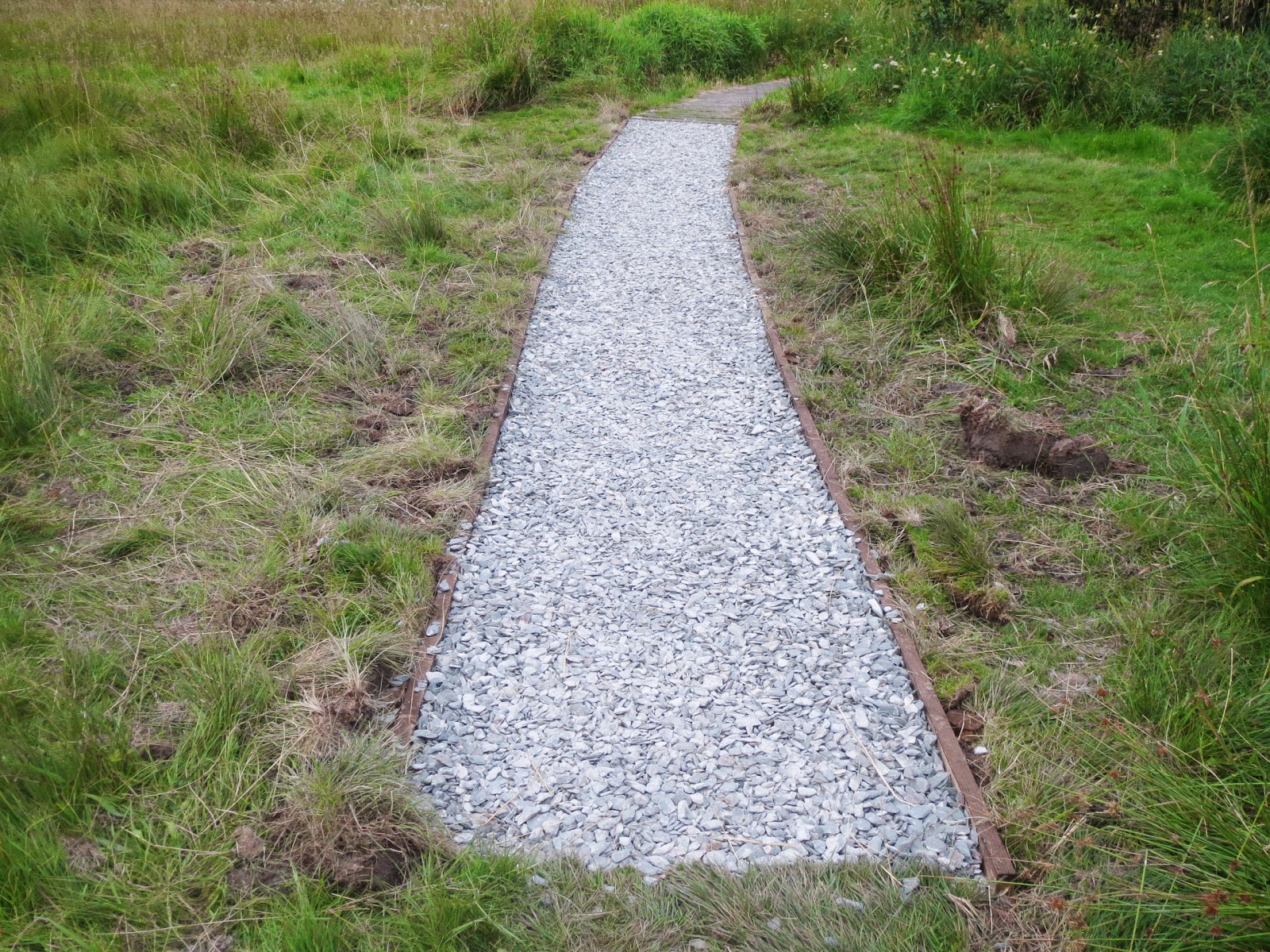
Birdhouse Meadow is located at the North end of Windermere. The ground in places is very soft, and with so much useage by locals and visitors, the ground gets very boggy. It was decided to link the existing boardwalks with a hard surface. 15/30 stone from Elterwater was ideal.
Digging out the turf to make way for the stone. the turf is used for landscaping
The rails will hold the stone in place and determine the width of the path.
Fastening the rails to fence posts; they will be sawn level with the tops of the rails
The finished section. Walkers were passing by and commenting on how good it looked.
Another section close to being finished.
A well earned break by the river.
The gates at either end of the boardwalks were treated to a coat of cuprinol.
Looking Good. With Thanks to the Cumbria National Trust Volunteers for all their help in improving the ease of use and the looks of the footpath.

Thursday, 25 July 2013

Champion Trees of Ambleside

Towering over the North East shore of Windermere – Skelghyll wood can be spotted well before arriving.  The give-away?  Some of the tallest conifer trees in Cumbria and the tallest of their kind in England.

The arboretum created by plant hunters over 150 years ago

You’d be forgiven for not seeing the majestic wood as you negotiate busy traffic and sharp bends in the road to Ambleside.  But once seen, the wood and its colossal trees will stand out for miles around.

Unlike the tall trees of other continents these can be reached in only a few minutes walk from Waterhead, just south of Ambleside and close to public transport links including the ferry.  Skelghyll wood is already very popular with walkers and cyclists travelling from Ambleside to Troutbeck via the very popular viewpoint called Jenkins Crag.

Visitors to Stagshaw gardens at Skelghyll wood will have already seen a glimpse of the tall trees, but now we’ve opened up a brand new path to enable visitors to marvel, up close and personal at the Champion trees.

A young visitor marvels at the size of a Wellingtonia
The Victorians, famous for their plant hunting had a big influence on Skelghyll wood and planted over 150 specimen conifer trees from all over the world including South and North America, Japan and Europe.  Some of these have trees have thrived on the lush wooded slopes and survived harsh winters and storms to become over 50 meters high – higher than 12 double-decker busses stacked on top of each other.

The tallest is a Grand fir measuring 58 meters (190ft) high making it the tallest tree in Cumbria and the North West, and the tallest Grand fir in England.  Other Champion trees found in the wood include Douglas fir, Wellingtonia, Western Red cedar, Hondo spruce and Blue Colorado spruce, all of which are the tallest of their kind in Cumbria.

The residents of Wansfell Holme planted trees from around the world as a way to show off their wealth and status

The planting vision set out in 1860 by the Victorians can finally be appreciated and the new Champion Tree Trail is a ‘must-see’ for anyone interested in trees, history or simply being in wonderful places that make you realise that nature is capable of huge things.

Although the path is now open the story has only just started.  We want to plant what will be champions of the future and to add to the new trail, making it a favourite place for generations to come.

The adventure for you and your family can begin in Waterhead and simply walking to Skelghyll wood or parking at Stagshaw Gardens car park nearby where the start of the new trail is located.

Take 45 minutes to stroll in sturdy footwear along the route taking advantage of picnic benches to marvel at what nature can do, with a little help from Victorian plant hunters. 
Beetles like this Longhorn (Rhagium mordax) love Skelghyll Wood too!

The trail is available to download as a PDF at

If you would like find out more about the trees or read our donations wish list  please get in touch with Ben Knipe – Woodland Ranger on 015394 46402 or email Benjamin.knipe@nationtrust.org.uk

Enjoy your walk and don’t forget to pack a picnic!

Thursday, 18 July 2013

Aira Force red squirrel trail.

The red squirrel was once a common sight throughout the whole of the UK but it is now an endangered species with only about 20,000 left in England and Wales, mostly in Cumbria and Northumberland.
Aira Force is well known for its waterfall and specimen trees but it has also become a place of sanctuary for our native and increasingly rare red squirrels. Working in partnership with the Penrith & District Red Squirrel Group, the National Trust has created a safe haven for these enchanting creatures by introducing a red squirrel trail, with strategically placed feeders, on the footpaths up and down the falls, thereby giving visitors the opportunity to glimpse red squirrels in the wild.

Red squirrel feeder

The decline of reds is directly attributable to grey squirrels which were introduced from North America in 1876 and whose population has exploded to in excess of 2.5 million. The bigger grey displaces red squirrels over time by out competing them for food but more critically as a carrier of the highly contagious Squirrelpox Virus (SQPV) to which they seem immune but is fatal to red squirrels.

With very kind donations from Garfield Weston and the John Speddan Lewis Foundation we have been able to  install a couple live cameras focused on squirrel feeder, they  relay pictures back to a monitor in the main car park so people can see the red squirrel close up without disturbing them. Here the camera is pointing at one of the  wooden feeders.

Another of the cameras attached to a tree.

This is the monitor displaying the picture in the info shelter in the car park.


And the proof it does work, here is a red squirrel feeding from the feeder.
If we can keep helping the red squirrel by feeding and controlling the greys our visitors will be able to see them for years to come. 

Friday, 12 July 2013

Balsam Bash at Troutbeck.


A VOLUNTEER GROUP ON A WORKING HOLIDAY AT AIRA FORCE ULLSWATER, TOOK TIME OUT TO HELP US FOR AN AFTERNOON AT EAST WINDERMERE.

 A LARGE STAND OF THE HIGHLY INVASIVE HIMALAYAN BALSAM NEEDED TO BE REMOVED BY THE STREAM KNOWN AS TROUTBECK.
GETTING STARTED ON ONE OF THE LARGER STANDS.
 These dense stands of Himalayan Balsam will dominate river banks if left unchecked.
YET MORE BALSAM BEING DEALT WITH.
SEPARATING THE ROOT FROM THE STEM.
IF THE BALSAM WAS LEFT, IT WOULD HAVE SEEDED BY AUTUMN. MANY SEEDS WOULD HAVE FLOATED DOWNSTREAM, POTENTIALLY GERMINATING AND FORMING NEW STANDS OF HIMALAYAN BALSAM.

EACH PLANT CAN PRODUCE UP TO 800 SEEDS
A LARGE PILE OF BALSAM.
Native plants should now be able to make a return with the balsam removed  from the banks.
 VOLUNTEERS. YOU DID A GREAT JOB ON SUCH A HOT AFTERNOON. MANY THANKS TO YOU ALL.


Friday, 21 June 2013

Glenamara Park

Glenamara Park occupies a small north facing valley in Ullswater and covers an area of about 70 Ha.The National Trust acquired it in 2002 because of its ecological and historic importance with its scattered veteran trees and impressive dead wood habitat. The area was used as a deer park in the 16th and 17th centuries indicated by the substantial high wall around almost the entire perimeter. Other significant interests are a pre historic scoop settlement and the numerous charcoal pitsteads around the site.


Here you can just make out the park boundary wall running up the left hand side and coming round under the crags on the right. Due to the steepness of the slopes and the exposure of the site the wall often comes down and requires putting back up again.

The ranger team putting up two big wall gaps.

With the long history of grazing within the park, firstly by deer and then by sheep the trees that remain in the park are becoming very old. These old trees is one of the reasons why the park is so special, veteran trees are very important for wildlife due to the amount of dead wood and cavities which are ideal for nesting birds and roosting bats.  


This is an ancient Alder tree which is completely hollow.

This is a large Silver Birch with an unusual shape, it must have been storm damaged at some point.

Due to the grazing pressures over the years there were no young trees coming up to replace the veteran trees so we had to think of a way to try and get some tree regeneration going and it was decided to remove sheep from the site and replace them with 12 hardy cattle. Natural tree regeneration rather than planting was preferred because you retain the local tree provenance and by putting cattle on the site these would trample down the bracken and break up the ground to allow some tree regeneration.


It has been 10 years since we put the cows in and I'm happy to say the trees are regenerating well and in a few hundred years time we will have our next generation of veterans trees. 


Finally, this is the view from Glenamara Park, you can understand why the early settlers wanted to live here.

Monday, 10 June 2013

Legend of the Gentle Giant

Woodlands are places of myths, legands and ghost stories, and the evidence of one such tale can still be seen today on modern day maps.

Let me tell you the story...

In the reign of King Edward VI there was Hugh Hird, the Troutbeck Giant, who was supposed to be the son of a monk from Furness Abbey.  Hugh was noted for his feats of strength and could lift huge weights that would cause even ten men to struggle with.  He was employed in the district to move great boulders and uproot trees single-handedly.

Hugh had the chance to demonstate his strength to the monarch and became a favourite of the court.  His appetite was as big as Hugh himself, and he could eat an entire sheep at a sitting, as well as porridge thick enough for a mouse to walk over for breakfast.

The King promised him any gift he could reasonably bestow, and along with a simple dwelling he asked for a stand of timber for fuel which became known, and still is today, as Hird Wood.


Hall Hill, the final resting place for the Giant of Troutbeck can be seen on the right in the forground, with Hird Wood, a National Trust woodland in the background.  Troutbeck Park Farm, one of Beatrix Potter's favourite farms can be seen peeping through the trees in the centre.


Could this have been Hugh's humble 'tenement'? (Forgive the out-of-season photo!) The valley of Troutbeck beyond is the best wood-pasture in the Lake District, maybe even the best in England.  This valley will see some exciting changes over the next 2 years to restore more of this amazing habitat....watch this space!

Source: Ghosts and Legends of the Lake District, J. A. Brooks 1988 Jarrold Publishing. 
ISBN 0-7117-0340-X

Ben Knipe
Woodland Ranger