Thursday, 26 July 2012

Secrets of the Ranger – The Cat and the Ferret

So how do you trace the route of a drain deep underground?  With a CAT and a ‘ferret-finder’ of course!

Let me explain….

The ‘ferret-finder’ is a device that screws onto the end of a drain rod, and emits a signal picked up by the CAT.  This is slid along the drain until a blockage is found.

Ray here with the CAT (Cable Avoiding Tool) which acts like a metal detector.  He sweeps it over the ground and it gives a loud beep when it locates the 'ferret-finder'.

Roland then slowly inserts the drain rods with the ‘ferret-finder’ on the end into the blocked drain.

X (or an arrow!) marks the spot.  Here is the blockage so we know where to dig.

No animals were actually needed for this task but 50 drain rods were!

Look out for more Secrets of the Ranger!

Ben Knipe
Area Ranger
Windermere & Troutbeck
 

Friday, 13 July 2012

A Bowness walk made even easier


This month the Windermere rangers have been busy working on a small project which will make a big difference to so many walkers.


Post Knott is a pretty field with a rock outcrop that looks over Bowness and Lake Windermere. 

It has a well used path through it which is wide and gentle until….you reach a tall wooden ladder stile.


The offending stile.  Easy for some to pass over, but difficult for many others.


With permission of the neighbour we set about taking this ‘dog stopper’ down and replacing it with a kissing gate.  This will allow those walkers with less mobility, walkers with push-chairs and dogs to pass through with great ease and safety.

Now over to the visitors of Post Knott and your comments on our work here….


“For us having a small dog those steps are quite tricky”

“That’s the worst one and the highest one”

“In wet weather they could be quite slippery, which is fine if you’re able”

“It’s the first time we’ve come across steps as high as that”

“About time it happened, it has been like that for too long!”
No guesswork was used as this was built to British Standards! (BS5709 to be exact).

“It will open it up to many more people”
Roland, one of the Windermere rangers is building a new quoin end to the wall.

“I think as walkers you just don’t appreciate how much work goes into the upkeep to make it easier for us”
No more nails.  Care and precision, and a dry spell in the weather was used to build the wooden pen.

“You can appreciate why the NT needs so much help from the public, it’s free for us to do this walk but in fact it’s quite an expensive upkeep”
The finished kissing gate with Brantfell in the background.

“As walkers we think you (the National Trust) are a very important body”
Walkers and their 4-legged friends enjoying the new gate.


“I think what you guys do is fantastic and the Lake District wouldn’t be the Lake District without you guys”


Post Knott is South East of Bowness on the way up to Brantfell, just a short detour from the start of the Dales Way long distance footpath.

It is a quiet, dog friendly location with great views over Lake Windermere and a perfect place to take a picnic and unwind with nothing but the sound of crickets on a sunny afternoon.


Ben Knipe
Area Ranger, Windermere & Troutbeck


Monday, 9 July 2012

Working Holidays

Working holidays have been going since 1967 and make a real contribution in engaging supporters, environmental understanding, conservation activities, budget savings and meeting our mission.
Participants join interesting activities, learn new skills, have new experiences and provide thousands of work hours.

Groups are over 18 years old, up to 12 people and have a volunteer leader and assistant. They stay in bunkhouses or cottages and cook good meals. 16 to 18 year olds can do Youth Discovery working holidays and their Duke of Edinburgh’s award.

Working holiday activities range from hedge laying to charcoal making, walled gardening to cider making, moorland surveys to conserving collections, winter crafts to John Muir discovery awards. Many combine these activities with leisure activities such as photography or surfing.

Working closely with properties and locations, the holiday’s team help to develop and assist a programme of week holidays and short breaks across England, Wales and Northern Ireland.

To find out more or get involved follow this link Working holidays

Saturday, 16 June 2012

To Conserve and Protect! The Netted Carpet Moth and the Touch-Me-Not Balsam plant.

The strikingly patterned Netted Carpet Moth resting on an elder below which are growing many hundreds of touch-me not balsam plants at St. Catherine's. 
The Netted Carpet Moth (Eustroma reticulatum) is one of the rarest moths in the U.K; (reticulum is Latin for small net). The UK Biodiversity Action Plan (BAP) classes the moth as a priority species; it is listed as vulnerable in The Red Data Book.

Netted Carpet Moth on Balsam Leaf. Late July. Image courtesy of  John Knowler.
The moths lay their eggs singly on the plants in July and August.
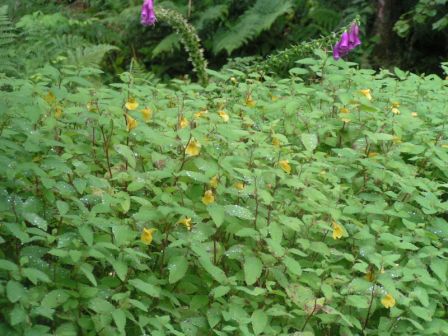
It is vulnerable mainly because the moth larvae/caterpillars are entirely reliant on a scarce annual plant known as Touch Me Not Balsam (Impatiens noli-tangere). It is the caterpillars' only food source.

Both the moth and the plant, which is the only balsam native to the UK , are restricted almost exclusively to the Lake District, albeit in small numbers, and at just a few sites.

One such site is at St Catherine’s in the East Windermere area.

Netted Carpet Moth Caterpillar on Touch Me Not Balsam at St Catherine's. Late August. note partly eaten seed pod. Caterpillars will have pupated on the ground by October. Adult moths emerge in July and may be seen until mid August.
National Trust Rangers have greatly increased the numbers of plants here, and hence the annual moth populations over the years, by actively improving conditions for the plant.

Touch Me Not grows well in damp open woodlands, especially after the ground has been disturbed. Without regular ground disturbance - in Winter and or early Spring - plant colonies will decline, becoming overwhelmed by perennial species such as brambles and creeping buttercup. Severe ground disturbance and the pulling up of brambles are tasks undertaken by rangers and volunteers at St. Catherine's  before the seedlings appear. 

 A good stand of Touch Me Not Balsam at St Catherine's. Mid July 2011
Touch Me Not also requires dappled sunlight to grow well; some wooded areas are managed with this in mind; branches have been cut back, and a certain amount of coppicing takes place.

Touch Me Not Balsam seedling appearing in Spring. Millerground.
A bumble bee pollinating Touch Me Not Flower. Millerground Late July 2011
At Millerground, in 2009, the cutting down of non native trees has let in a lot more light. This has allowed touch me not plants to be reintroduced, and to thrive here once again after many years absence.

The annual Netted Carpet Moth Survey, that takes place in early September, has already recorded Netted Carpet Moth caterpillars to be present at this site which is very encouraging news.

A Netted Carpet Moth Caterpillar forming a triangle between leaf stem and stalk.
A Netted Carpet Moth Caterpillar munching on a seed pod!.......image courtesy of John Hooson.
Finally, invasive, non native Himalayan Balsam is pulled out regularly to prevent it from overwhelming and displacing the far less common and much less competitive or robust Touch Me Not Balsam stands.

Himalayan Balsam (pink flower) encroaching on Touch Me Not.
Pulled out shortly after photo was taken!

Roland Wicksteed: Central and East Lakes.

Wednesday, 6 June 2012

So far no sign of.... A return of the giant Hogweed.... At ferry Nab!!

In June 2011, several Giant Hogweed plants were found to be growing alongside the National Trust/SLDC footpath at Ferry Nab. A National Trust Ranger wearing full protective clothing and goggles dug out the plants and then burnt them.

The Giant Hogweed plant (HERACLEUM MANTEGAZZIANUM) is a native of the Caucasus region, and Central Asia. Victorians brought it back for use as an ornamental garden plant. It is able to grow taller than 15 feet, and more! 

Giant Hogweed’s flower head in June 2011. Cockshott point/Ferry Nab

The sap contains “furanocoumarins,”a toxin that photosensitises the skin. Exposure to sunlight causes painful blistering. The scars can take years to heal. A small amount in the eyes has been known to cause temporary or even permanent blindness.

This plant often causes river bank erosion...its favourite place to grow. When it dies back in Winter, often only bare ground remains. 


 The Giant Hogweed can easily shade out native plants because it grows so fast and so tall; it becomes dominant very quickly if not controlled.


The Giant Hogweed, classed as a biennial, lives for between two to Seven years. In its final year it produces the flower heads, each containing up to 5,000 seeds, seeding in late August. The seeds remain viable for up to seven years in the ground.


Giant Hogweed at Ferry Nab bordering SLDC and N.T footpaths at Ferry Nab leading to Cockshott Point. Note size of plant compared to large trenching spade. Plant APPROX 15 feet tall! Native plants under threat include Touch Me Not Balsam


A recent survey in this area indicates there is no sign of regeneration of the plant..as yet! Further monitoring will take place later this year.

Wednesday, 23 May 2012

Have a great time on one of our working Holidays

Working Holiday May 2012

Ever wanted to Wake up in a beautiful location, and enjoy a fun-packed day doing exciting conservation activities, and make great new friends in the process with one of our working holidays?

Well this is what these guys did. Taking part and getting active on one of our working holidays. Fun packed week with twists and turns but a fantastic experience, learning about this part of the Lake District, doing some great conservation work and getting a chance to have a go and enjoy a brilliant outdoor activity.

Sarah encouraging rides in her wheelbarrow

The First day the Volunteers and Rangers worked hard on the shores of Grasmere to remove tree saplings along the path and shore. This work is important to do while the trees are young, many have self seeded but removing them helps keep the mature trees healthy encourages smaller wild flora to grow and ultimately retaining the beautiful views across the Lake and fells. We also have a special event coming up on June 9th this year the Grasmere Gallop 10k trail race. We are hoping this year’s race will attract 500 plus runners of all ages to enjoy what must be one of the most beautiful routes in the country. For more details follow this link Grasmere Gallop

Katie and Alan removing tree saplings, not a bad view
Adam looking cool, modelling that Bow Saw
Grasmere water from Loughrigg

The rest of the week was spent at High Close Garden near Langdale. The house that sits in this 11 acre site is used by the YHA. The original building has been extended over the years but we think there would have been a wooden structure here since the 15th century. The garden covers 11 acres and is part of the High Close estate which totals 535 acres. The garden was originally planted in the 1860s by Edward Balme and was laid out in the fashion of the day using many recently discovered exotic conifers from North America as well a variety of Rhododendrons. In its time the garden would have employed 9 gardeners and a full time path sweeper. The maintenance has been undertaken by the Rangers and volunteers and this work is now ongoing to bring the garden back to life. 

Roger clearing vegetation from around a 200 year old "Corting" seat

The gang worked very hard all week with some inclement weather for May but this did not dampen there sprits. Work has been ongoing in the garden to remove Rhododendron from the site. We collected logs and brash to burn for the fire. Paths that had become over grown and covered with soil and leaf mould were dug off and landscaped and resurfaced with local slate. Drains were cleaned and reinstated.

Bernard discovering old drains
Alan digging of turf
Twisted fire starters
Krisi taking our barrow for a spin
We use crushed slate from a local quarry in Elterwater
The gang cant wait to get there barrows full
Raking the slate level
Perfect
Katie showing us the before shot
And after
Magic
One happy customer

We add a full day on Windermere using Canadian canoes and kayaks as part of the holiday, this gives first timers a chance to try a new sport and for others to view the Lakeland fells from a different perspective. There is nothing better than bobbing about on the water enjoying fantastic views and great company.

Canadian canoes on Windermere
A chance to try out Kayaks
Experts in the field of Kayaking
Time to relax and enjoy many fabulous locations the Lakes has to offer

Our Working Holidays provide a great way to learn new skills, help our work, see new places and have fun with like-minded people. There are plenty of Working Holidays to choose from with locations country wide. Go on, give it a go. Find out more and get involved by following this link National Trust Working Holidays

Tuesday, 1 May 2012

Elterwater's biodiversity under threat?

The reed beds and Touch me not balsam stands at Elterwater are being invaded by the American skunk cabbage, a perennial plant with an estimated life span of over 80 years! 

National Trust Rangers are digging up smaller plants, and destroying the seed pods of older specimens. The aim is to limit the spread of skunk cabbage,and prevent it from displacing the native plants at Elterwater.

Image of small skunk cabbage, freshly dug up. Note size of root system

Image of skunk cabbage growing in Touch me not balsam stand and reeds.Young Balsam seedlings in 1/2 moon shape around skunk cabbage

Image of large stand of older skunk cabbage. Note younger plants in right foreground.

Image of medium size skunk cabbage just dug up with a lot of effort! Note massive root system

One of the largest skunk cabbages we found...we nicknamed it GODZILLA! To put things in perspective, the chain saw boot is a size 10.

A trailer full of skunk cabbage.

These plants represent a small proportion of invasive species that are threatening our countryside; the National Trust and many other organisations, with help from volunteers, are making a stand against such species. 

A lot of resources are also used to try and combat the spread of Himalayan Balsam and Japanese Knotweed. Please keep checking the blog for more posts about this issue.